Worldwide, migration from rural to urban areas has accelerated rapidly, particularly with the effect of the Industrial Revolution. As a natural result, the urban population has grown quickly and urban areas have expanded rapidly. Meeting the need for mobility — one of the most important parts of life, i.e. the need to reach a destination — has also begun to become a problem along with these increases. Although solutions were initially sought by widening and expanding road networks, over time it was observed that this was not actually an adequate solution and in some cases even increased the problem. The possibility that expanding road networks could worsen the existing traffic problem by increasing travel times was first raised by German mathematician Dietrich Braess in 1968 with his observation known as "Braess's paradox".
Over time, it became clear that expanding and widening the road network alone could not solve traffic problems, and it was realized that, in addition to eliminating this problem, humanity also needed to improve human mobility from perspectives such as sustainability, comfort and safety. This need for improvement began to be addressed with momentum thanks to developing technology. In recent years, experts working toward this goal have brought the technology and transport sectors together and begun to deliver improvements in terms of sustainability, comfort and safety.
Intelligent Transportation Systems
There is no universally accepted definition for Intelligent Transportation Systems (ITS). Instead, there are many definitions in the literature. Although these definitions may seem different from one another, they actually rest on a common foundation. This foundation can be summarized as the use of information and communication technologies to improve transportation systems in terms of comfort, safety, efficiency and environmental sensitivity.
ITS should be treated as a discipline that encompasses the definitions as a whole. Moreover, as a goal, it should embrace the realization of engineering applications such as making the transportation system more efficient, increasing road safety, reducing negative environmental impacts, and researching, planning, designing, integrating and commissioning systems that facilitate management steps.
When ITS is treated as a discipline, it also includes elements such as strategic planning, interoperability, real-time data collection and monitoring, defining system architectures, and operability across multiple modes and different authorizations. When ITS is examined under the conditions of our era, it is possible to see that the systems are generally built on advanced-technology IT or electrical-electronic systems and are complementary to these systems because they use various up-to-date data banks. One of the most important elements of ITS is the necessity of being in constant communication with a central management unit; and the fact that it incorporates passengers and vehicles — that is, every kind of transport element that plays a part in transportation.
ITS stakeholders consist of a group that includes, within a multidisciplinary structure, a wide range of technical experts and many different users. Each stakeholder needs to transfer their own knowledge and perspectives to the discipline in order to plan, develop, manage and operate a multimodal ITS. ITS stakeholders consist of experts from many different disciplines somehow related to transport infrastructure: electrical and electronics engineers, civil engineers, systems engineers, urban and regional planners, logistics, finance and business experts, emergency personnel and more.
History of Intelligent Transportation Systems
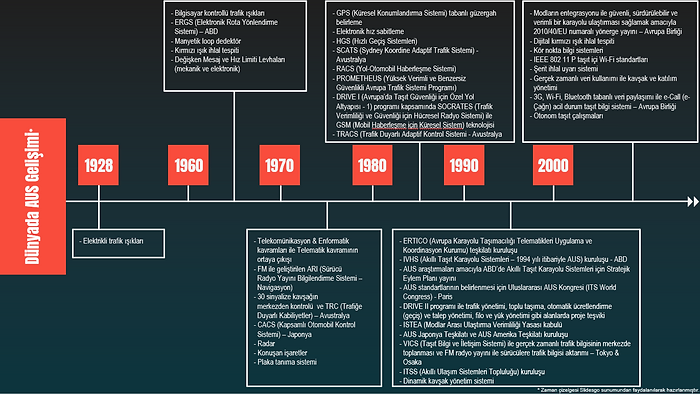
Globally, the electric traffic lights used in 1928 are accepted as the first ITS applications. In addition, computer-controlled traffic signalization systems, which began to be used in the 1960s partly due to the development of computer systems, are an important building block in the history of ITS.
In the 1970s, electronic message signs, inductive loop detectors and occupancy/density measurement devices came into use. In the 1980s, corridor-based traffic management and enforcement applications began to be developed, and along with this, traffic control centers became widespread in the 1990s. By the 2000s, with a better understanding that traffic problems could not be solved merely by managing vehicle traffic, the use of ITS technologies in public transport systems was expanded in an effort to increase the utilization rate of public transport. In addition, passenger information systems developed rapidly in the 2000s. Over the following 5-10 years, electronic fee-collection systems and phone applications for traffic management were also developed.
In today's technology age, ITS continues to develop rapidly with the use of the Internet of Things and artificial intelligence; and alongside these, thanks to developing communication technologies, cooperative intelligent transportation systems (C-ITS) — in which communication is established between vehicles and their environment — have emerged.
Cooperative Intelligent Transportation Systems
Today, it is impossible to think of transportation systems independently of interconnected, technology-focused systems, even though they operate in different fields. The most critical factor for these systems — whose foundations are laid by different disciplines — to work together with transportation systems is information and communication technologies. Thanks to this multidisciplinary structure, safety, increased efficiency and a reduction in environmentally harmful effects are planned in the transportation ecosystem. In addition to these positive effects, it is thought that the effective use of developments in the information and communication sector within the transportation ecosystem will also benefit the telecommunications sector, along with the increase in internet-based services and internet traffic.
Intelligent Transportation Systems (ITS) are developing rapidly with the blending of information and communication technologies such as next-generation mobile broadband technologies, IoT (Internet of Things), M2M (Machine-to-Machine communication) and V2X (Vehicle-to-Everything), together with developments in cloud computing and the automotive sector. As a result, in recent years, work in the field of intelligent transportation has led to the emergence of Cooperative Intelligent Transportation Systems (C-ITS), in which vehicles can communicate with each other, with infrastructure, or with other components in the transportation ecosystem. In other words, C-ITS is the state in which all ITS subsystem elements interact with each other through communication technologies, especially next-generation mobile broadband technologies. The connected, cooperative operation of the elements in the transportation ecosystem offers great potential — depending on the nature of the applications — to increase road safety and improve the overall efficiency and environmental performance of the transportation system.
Within the C-ITS framework, communication is basically examined in four parts. These can be listed as vehicle-to-vehicle (V2V), vehicle-to-infrastructure (V2I), infrastructure-to-vehicle (I2V) and vehicle-to-everything (V2X). While this communication is being established, the main objective is to ensure that all the elements in the transportation ecosystem are aware of each other and therefore appear in this ecosystem in synchronization.
V2V services describe the exchange of data between two nearby vehicles. V2V services are primarily expected to be used in road-safety applications. V2I and I2V services describe the exchange of data between a vehicle and roadside stations, or between a vehicle and an application server. V2I and I2V services are expected to increase road safety and traffic efficiency and reduce energy consumption. V2X services, as the name suggests, are two-way data exchanges between vehicles and everything that is a member of the transportation ecosystem (pedestrians, etc.).
C-ITS, as the name implies, is based on cooperative operation and, together with connected driving systems, plans to ensure the continuity of the traffic ecosystem in the long term with autonomous vehicles. In this way, it will be possible to facilitate the exchange of information for actions in transportation, and therefore the coordination of the ecosystem will become easier. With autonomous driving, vehicles are intended to take over the driver's role and become part of the transportation system. With different levels of autonomous driving and different degrees of driver involvement, it can be envisaged that detection, decision-making and maneuvering skills will be entirely delegated to the vehicle. Autonomous driving levels start from level zero and continue up to level five, which is fully autonomous:
- Level 0: The level with no automation, where all functions are performed by the human.
- Level 1: The level where the vehicle only assists the driver in certain situations (speed, steering control, etc.). All responsibility lies with the driver.
- Level 2: At this level, which can be considered partially autonomous, the vehicle can fully control steering and speed in some specific situations. The driver must be ready to take control at any moment and know that responsibility lies with them.
- Level 3: The level where responsibility passes to the autonomous system. The system controls steering and speed.
- Level 4: The vehicle controls all the details. Responsibility lies with the system.
- Level 5: In this fully autonomous system, responsibility lies entirely with the system. The vehicle must be able to do everything a human can do.
C-ITS services, which are constantly expanding with developing technology, are examined by the European Transport Safety Council (ETSC) and the European C-ITS Platform (Ertico) by basically dividing them into 2 groups. These are Day 1 and Day 1.5 services.
Day 1 services are generally considered initial services. Due to the technological maturity and expected societal benefits of Day 1 services, they are expected to come into use in the short term. Day 1 services are summarized in the table below.
Day 1.5 services, although not fully ready in terms of technical specifications and standards, are defined according to the existing or future needs of transportation systems. Day 1.5 services are summarized in the table below.
The main headings of the important developments in the history of C-ITS are expressed chronologically in the figure below.
Because the C-ITS ecosystem is directly related to technology, the pool of ecosystem services is rapidly expanding and changing as communication options and related technologies develop continuously. Closely and continuously following this development and adapting to it is extremely important for countries' goals of improving their transportation systems.
REFERENCES
Academy — ERTICO. Accessed: 27 June 2020. ertico.com/academy
European Commission. (2018): Horizon 2020 – Work Programme 2018-2020 Information and Communication Technologies, Brussels: European Commission.
Engineers, A. S. (2015, December 15). Intelligent Transportation Systems – History & National Perspective. Accessed: 29 June 2020. slideshare.net
ETSC. (2017): Briefing Cooperative Intelligent Transport Systems (C-ITS). Brussels: European Transport Safety Council.
European Transport Safety Council. Accessed: 19 June 2020. etsc.eu
Koyuncu, A. Ş. (2018). Examination of the European Cooperative Intelligent Transportation Systems Strategy and Recommendations for Türkiye's National Intelligent Transportation Systems Strategy (Transport and Communication Expertise Thesis). Ankara.
Tufan, H. (2014). Intelligent Transportation Systems Applications and a Proposed ITS Architecture for Türkiye (Transport and Communication Expertise Thesis), Ankara.