
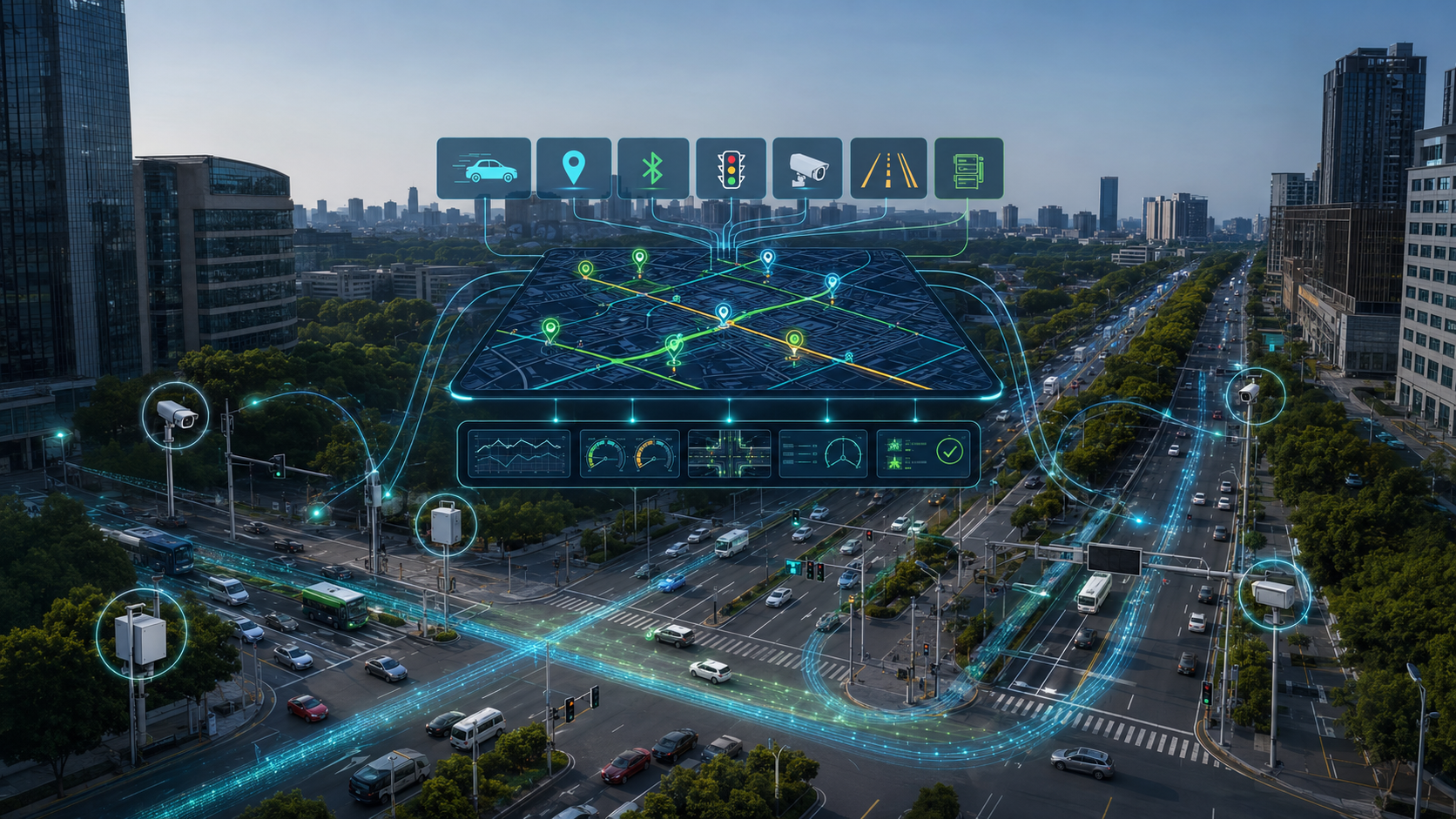
In cities, junctions, cameras, and roadside sensors continuously generate traffic data. This data needs to be monitored, interpreted, and turned into operational actions from a central platform. MANGO supports integrated traffic management within a single centralized operating environment.
What Is MANGO?
MANGO (Manage & Go) is a next-generation city management platform designed to centrally monitor, analyse, manage, and remotely control citywide traffic management systems, field equipment, and sensor networks. Through its web-based user interface and digital mapping infrastructure, real-time data from signalised junctions, cameras, variable message signs (VMS), and traffic sensors can be displayed on a unified operational dashboard.
In this respect, MANGO is not merely a software solution that sends commands to junction signalisation systems; it is a centralised traffic management platform that integrates real-time and historical traffic data with field systems while providing operational visibility for remote management and decision-support processes.
From Field Data to Operational Decision-Making
MANGO's operational workflow begins with data collection from the field. Information received from components such as signalised junctions, cameras, traffic sensors, and variable message signs is consolidated within a centralised environment. While displaying real-time data on a digital map, the platform also supports the statistical analysis and reporting of historical records.
Through this unified interface, operators can assess changes in traffic density, junction status, signal plans, and field equipment notifications. Authorised management functions enable operational decisions to be implemented in the field, such as remotely controlling junctions or updating signal plans.
The Use of MANGO in Traffic Management Centres
Municipal transportation departments, road authorities, and traffic management centre teams can use MANGO as part of an Advanced Traffic Management System (ATMS) to monitor daily operations, manage junctions and corridors, track the status of field devices, handle faults, and report on system performance. Through the platform, directional traffic volumes, vehicle density, average speed, real-time signal phase status, green times, and active signal plans can be evaluated within a unified operational context.
Speed and travel-time data generated from Floating Car Data (FCD), GPS, and Bluetooth-based data sources support the creation of real-time traffic density maps, the monitoring of changes in traffic flow, and origin–destination (O–D) analyses. Camera feeds also enable the visual verification of sensor data and field notifications.
Modular Structure Tailored to Operational Requirements
MANGO's modular and interoperable architecture enables functions such as dynamic junction management, camera management, performance analysis, traffic insights, integrated corridor management, and Variable Message Sign (VMS) management to be configured in accordance with an organisation's operational requirements. This allows the platform to be deployed with only the required modules and expanded with additional capabilities as the scope of the traffic management centre grows.
Floating Car Data (FCD), GPS- and Bluetooth-based mobility data, and traffic measurements obtained from cameras and junction sensors are integrated within MANGO's data layer, contributing to the generation of road-segment-level information on speed, traffic density, traffic flow, and travel times. These data can be used to create real-time traffic density maps, assess corridor performance, and analyse traffic patterns using historical records.
Institutional Benefits of Integrated Traffic Management
A unified platform approach reduces the need to switch between different field systems, providing traffic management centres with a more comprehensive operational overview. Furthermore, the platform's modular and scalable architecture enables cities of varying sizes to establish a management model tailored to their existing field infrastructure and operational priorities.