
Sustainability in Transport
As the world population grows rapidly, the concept of "sustainability" has become an agenda item in transport, as in every field of life. A growing population brings with it transport needs, which in turn cause an increase in private-vehicle traffic. The environmental impacts caused by heavy vehicle traffic raise concerns about health and livability. To achieve energy efficiency and reduce carbon emissions, the use of alternative-fuel, low- or zero-emission transport modes that embrace the sharing economy — such as bike-sharing systems, electric scooters and shared electric vehicles — represents environmentally friendly solutions in transport. In work to promote the use of these modes, the factors that influence users' preferences need to be known and taken into account.
Cultural structure, land use, socio-demographic characteristics and the built environment differ from city to city. This difference in urban form also makes travel habits and behaviors different. For systems to serve successfully, user behaviors and spatial characteristics need to be analyzed for each specific city. By identifying the factors affecting the use of a sharing system, the improvements made to the system increase administrations' success in their transport strategies.
An Active-Travel Alternative in Sustainable Transport: Micromobility
Micromobility refers to lightweight vehicles that generally travel at a maximum speed of 25 km/h and are used privately or in shared systems. In recent years, with the spread of sharing systems, micromobility vehicles such as bikes and e-scooters have become quite popular. While micromobility vehicles are a fast and eco-friendly alternative for short-distance trips, they are also an economical solution for first- and last-mile transport (Dündar et al., 2022). Micromobility sharing systems appear in cities with different operating types, such as docked and dockless systems.
Although e-scooters became popular and entered our lives recently, the bicycle has been used for urban transport, for recreational or commuting purposes, for many years. Particularly in cities where cycling culture has not developed as a transport mode and is used for recreation or sport, a sustainable transport strategy should be put forward by analyzing user behavior in the city in order to integrate cycling into urban transport systems. The temporal and spatial factors affecting the use of Bike-Sharing Systems (BSS), which exist in many cities worldwide, have been the subject of academic studies (Table 1).
| Country – City | Factors Affecting Use | Reference |
|---|---|---|
| USA – Chicago | Weather, Cycling Infrastructure | Hyland et al. (2018) |
| Singapore | Cycling Infrastructure, Built Environment, Public Transport, Weather | Shen et al. (2018) |
| USA – New York | Weather, Terrain | An et al. (2019) |
| China – Ningbo | Public Transport, Attraction Points | Ma et al. (2019) |
| China – Shanghai | Built Environment, Land Use | Du et al. (2019) |
| Germany – Cologne | Socio-demographic Characteristics, Land Use, Built Environment | Schimohr and Scheiner (2021) |
| Canada – Montreal | Cycling Infrastructure, Public Transport | Wang et al. (2021) |
| Poland – Krakow | Weather | Pazdan et al. (2021) |
| Türkiye – İzmir | Land Use, Cycling Infrastructure | Pekdemir et al. (2024) |
Locating bike-sharing stations near public-transport stops such as metro, tram and bus stops facilitates users' access to public transport and encourages them to use these systems. In addition, locating stations near city squares and attraction centers also has a positive effect on cycling. Like station location, the infrastructure characteristics of the routes on which the bike trip will take place are also very important for cycling. The presence of protected cycle lanes — separate from areas designated for vehicles and pedestrians, where the user feels safe throughout the trip — encourages the use of bike-sharing systems. The fact that bike parking areas are easily accessible, safe and user-friendly plays an important role in the effective use of sharing systems.
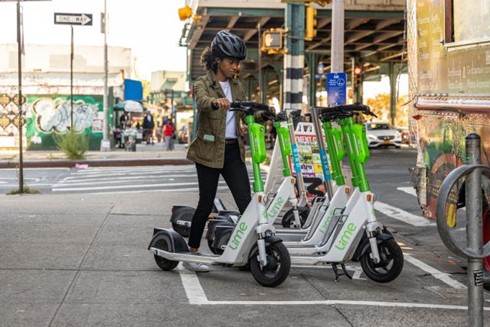
Shared e-scooters have also become quite popular in recent years and their use has become widespread. Because e-scooters have no parking areas and no obligation to be left in specific areas, they enable flexible trip planning (Altıntaşı and Yalçınkaya, 2022). As such, they are frequently preferred for short-distance trips, such as getting from home to the metro. Because they are electric, they are an easy and enjoyable transport alternative that does not require the user to make a physical effort. Alongside the conveniences they provide, debates about e-scooters continue. Because they are not station-based, leaving them haphazardly on sidewalks creates visual pollution and restricts the area reserved for pedestrians. In addition, because there are no lanes reserved for e-scooters, urban roads or sidewalks are used for e-scooter trips, and this creates an accident risk (Dündar et al., 2022). Studies investigating the factors affecting e-scooter use are shown in Table 2.
| Country – City | Factors Affecting Use | Reference |
|---|---|---|
| USA – Austin | Residential, Commercial, Educational and Industrial Land Areas | Caspi et al. (2020) |
| Korea – Seoul | Socio-demographic Characteristics | Lee et al. (2021) |
| USA – Chicago | Perceived Benefit and Perceived Reliability | Javadinasr et al. (2022) |
| USA – Minnesota | Educational Areas and Attraction Centers | Bai and Jiao (2020) |
| USA – Louisville | Socio-demographic Characteristics and Distance to Public-Transport Stations | Hosseinzadeh et al. (2021) |
| Austria – Vienna | Traffic Density, Pedestrian Density | Markvice et al. (2020) |
| USA – Chicago | Public Transport | Smith and Schwieterman (2018) |
According to the Electric Scooter Regulation prepared jointly in April 2021 by the Ministry of Transport and Infrastructure with the Ministry of Environment and Urbanization and the Ministry of the Interior, e-scooters are prohibited from being ridden on the carriageway where a cycle lane is present, on pedestrian paths, on roads with a speed limit above 50 km/h, from being used by those under 15, and from carrying passengers other than the rider. In Türkiye, e-scooter sharing systems can operate provided that an Authorization Certificate is obtained from the Ministry of Transport and Infrastructure and permission is obtained from UKOME or the Provincial Traffic Commission in the cities where they will be used. Provided that the necessary permissions are obtained by the sharing-system operators and users comply with the regulation, the Ministry of Transport and Infrastructure supports the development of low-emission individual transport and the spread of micromobility.
An Innovative and Comfortable Urban Transport Mode: Shared Electric Vehicle Systems
According to data published by the European Parliament on climate change, private cars account for 61% of the carbon emissions from road transport. On short-distance trips, the occupancy rate of private cars is 1.3 passengers per trip. When occupancy rates are also taken into account, private cars not only cause congestion but also significantly increase individual and social transport costs. In addition, increasing private-car ownership causes parking problems in city centers. Shared-vehicle systems, whose popularity has grown in recent years with the development of technology, have the potential to be a solution to the negative effects of private-car use. Thanks to the rental option via a mobile application, they provide convenience for user access. According to research on electric-vehicle sharing systems, the factors affecting their use are as shown in Table 3.
| Country – City | Factors Affecting Use | Reference |
|---|---|---|
| Germany – Munich, Berlin | Weather and Socio-demographic Characteristics | Schmöller et al. (2015) |
| USA – Austin | Socio-demographic Characteristics | Kortum (2012) |
| China | Parking-Area Density and Education Level | Zu et al. (2024) |
Shared electric vehicles increase accessibility and mobility for users who do not own a personal car. These vehicles provide cost-effective urban mobility while supporting eco-friendly mobility by reducing transport emissions. In addition, equipping electric vehicles with next-generation intelligent transportation technologies serving the field of Cooperative Intelligent Transportation Systems (C-ITS) — which enable communication with infrastructure and other vehicles — provides a comfortable, safe and enjoyable transport experience. MANGO CAR, a 100% electric mini vehicle supported by Traffic Control Center Software that supports the vehicle-sharing model, can be an alternative for safe and comfortable travel in cities. For detailed information about MANGO CAR, you can review our catalog.
REFERENCES
An, R., Zahnow, R., Pojani, D., Corcoran, J., (2019). Weather and cycling in New York: The case of Citibike. Journal of Transport Geography. doi:10.1016/j.jtrangeo.2019.04.016
Altintasi, O., Yalcinkaya, S., (2022). Siting charging stations and identifying safe and convenient routes for environmentally sustainable e-scooter systems. Sustainable Cities and Society, Volume 84, 104020. doi:10.1016/j.scs.2022.104020
European Parliament. CO2 emissions from cars: facts and figures. Accessed: 8 May 2024. europarl.europa.eu
Bai, S., Jiao, J., (2020). Dockless E-scooter usage patterns and urban built environments: a comparison study of Austin, TX, and Minneapolis, MN. Travel Behav. Soc. 20, 264–272. doi:10.1016/j.tbs.2020.04.005
Caspi, O., Smart, M.J., Noland, R.B., (2020). Spatial associations of dockless shared e-scooter usage. Transp. Res. Part D: Transp. Environ. 86, 102396. doi:10.1016/j.trd.2020.102396
Du, Y., Deng, F., Liao, F., (2019). A model framework for discovering the spatio-temporal usage patterns of public free-floating bike-sharing system. Transp. Res. Part C: Emerg. Technol. 103, 39–55. doi:10.1016/j.trc.2019.04.006
Dündar, S., Günay, G., Karlikanovaite-Balıkçı, A., Şentürk Berktaş, E., et al. (2022). Micromobility – A Miracle Solution for Transport, or a Disappointment? İDEALKENT, 13(36), 576-598. doi:10.31198/idealkent.1066650
Hosseinzadeh, A., Algomaiah, M., Kluger, R., Li, Z., (2021). E-scooters and sustainability: investigating the relationship between the density of E-scooter trips and characteristics of sustainable urban development. Sustain. Cities Soc. 66, 102624. doi:10.1016/j.scs.2020.102624
Hyland, M., Hong, Z., Pinto, H. K. R. de F., Chen, Y., (2018). Hybrid cluster-regression approach to model bikeshare station usage. Transportation Research Part A: Policy and Practice. doi:10.1016/j.tra.2017.11.009
Javadinasr, M., Asgharpour, S., Rahimi, E., Choobchian, P., Mohammadian, A.K., Auld, J., (2022). Eliciting attitudinal factors affecting the continuance use of E-scooters: an empirical study in Chicago. Transportation Research Part F 87, 87–101. doi:10.1016/j.trf.2022.03.019
Kortum, K. (2012). Free-Floating Carsharing Systems: Innovations in Membership Prediction, Mode Share, and Vehicle Allocation Optimization Methodologies. PhD diss., University of Texas at Austin.
Lee, H., Baek, K., Chung, J.H., Kim, J., (2021). Factors affecting heterogeneity in willingness to use e-scooter sharing services. Transp. Res. D Transp. Environ. 92, 102751. doi:10.1016/j.trd.2021.102751
Ma, X., Cao, R., Jin, Y. (2019). Spatiotemporal Clustering Analysis of Bicycle Sharing System with Data Mining Approach. Information 10, no. 5: 163. doi:10.3390/info10050163
Pazdan, S., Kiec, M., D'Agostino, C., (2021). Impact of environment on bicycle travel demand — Assessment using bikeshare system data. Sustainable Cities and Society. doi:10.1016/j.scs.2021.102724
Pekdemir, M. I., Altintasi, O., Ozen, M., (2024). Assessing the Impact of Public Transportation, Bicycle Infrastructure, and Land Use Parameters on a Small-Scale Bike-Sharing System: A case study of Izmir, Türkiye. Sustainable Cities and Society, 105085. doi:10.1016/j.scs.2023.105085
Shen, Y., Zhang, X., Zhao, J., (2018). Understanding the usage of dockless bike sharing in Singapore. International Journal of Sustainable Transportation. doi:10.1080/15568318.2018.1429696
Smith, C., Schwieterman, J., (2018). E-Scooter Scenarios: Evaluating the Potential Mobility Benefits of Shared Dockless Scooters in Chicago.
Schimohr, K., Scheiner, J., (2021). Spatial and temporal analysis of bike-sharing use in Cologne taking into account a public transit disruption. J. Transp. Geogr. 92, 103017. doi:10.1016/j.jtrangeo.2021.103017
Schmöller, S., Weikl, S., Müller, J., Bogenberger, K., (2015). Empirical analysis of free-floating carsharing usage: The Munich and Berlin case. Transp. Res. C 56, 34–51. doi:10.1016/j.trc.2015.03.008
Ministry of Transport and Infrastructure, Ministry of Environment and Urbanization, Ministry of the Interior: Electric Scooter Regulation (2021). Accessed: 24 May 2024. resmigazete.gov.tr
Wang, X., Cheng, Z., Trépanier, M., Sun, L., (2021). Modeling bike-sharing demand using a regression model with spatially varying coefficients. J. Transp. Geogr. 93, 103059. doi:10.1016/j.jtrangeo.2021.103059
Zu, J., Kong, H., Xu, Y., Zhang, X., (2024). Carsharing in China: Impact of system and urban factors on usage and efficiency. Journal of Transport Geography, Volume 117, 103897. doi:10.1016/j.jtrangeo.2024.103897